Cloughey Presbyterian congregation formed
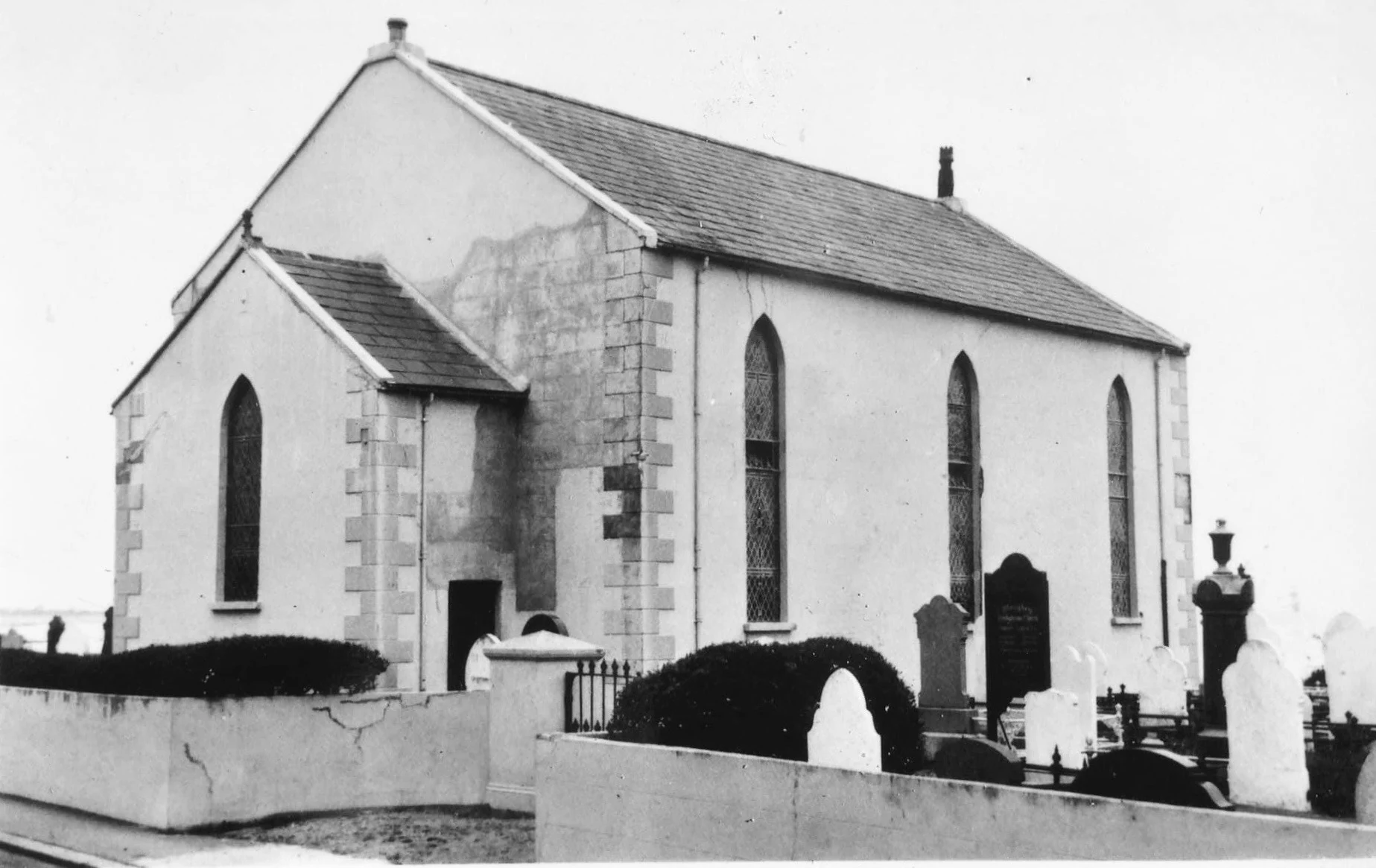
Cloughey Old Meeting House
A place at the heart of the community.
For more than a century the Meeting House was woven into village life. Cloughey Heritage Group is working to protect that history and give this important building a useful future once again.
The story begins
A congregation without a meeting house.
Cloughey's Presbyterian congregation was formed in January 1841. Before it had a permanent home, worship took place wherever suitable space could be found — including Kirkistown Castle, the local Sand School, a barn at Drumarden, a store at Ballyspurge and Cloughey Coastguard Station.
The documentary trail becomes particularly clear in 1841. Minutes of the Presbytery record formal thanks to John Echlin Esq. and the Rev. J. R. Echlin for granting ground in Cloughey for a Presbyterian house of worship. Contemporary newspaper evidence records the foundation stone being laid on 1 June 1842. The new Meeting House opened for public worship on 17 May 1843. Its first minister was the Rev. James Gamble.
That beginning says something important about the building: from the outset it was created by a local community determined to have a place of its own.
Meeting House opened for public worship
Shelter for survivors of the Wild Deer
Protected listed building
More than Sunday worship
A building that served its community.
For generations the Meeting House was a place of worship, family milestones, gathering and support. One extraordinary episode shows that wider role particularly clearly.
In January 1883 the emigrant ship Wild Deer, bound from Greenock for New Zealand, struck the North Rock off Cloughey. Hundreds of passengers and crew had to be brought ashore into what was then a very small village.
Contemporary accounts record that local homes could not accommodate everyone, so the Presbyterian minister opened the church to the shipwrecked passengers. The pews were filled with straw and turned into makeshift sleeping berths, while other buildings across the village were pressed into service. Food and shelter were provided and, after the immediate crisis, many of the rescued passengers attended worship in the Meeting House before continuing their journey.
When Cloughey suddenly had to care for hundreds of strangers, the Meeting House became part of the village's response.
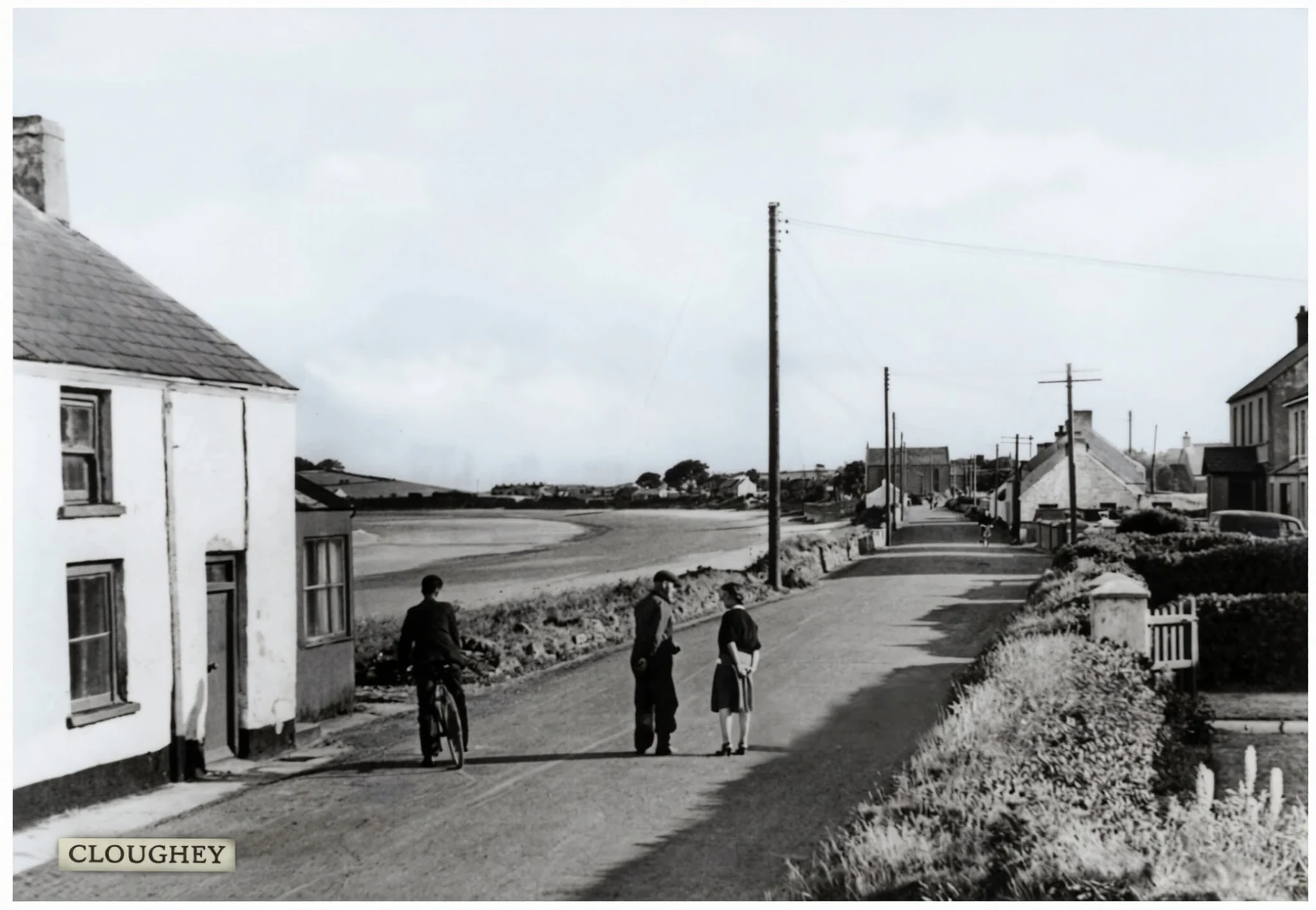
Cloughey grew around its shore, road and close-knit community. The Old Meeting House formed part of that village life for generations.
The building through time
Changed, but still recognisably the Meeting House.
The building we see today is not exactly the building that opened in 1843. A major renovation in 1902 changed the entrance and internal arrangement, reduced the original gallery and introduced the tall pointed windows that are now such a familiar part of its appearance.
The church also contains important stained glass, including five Clokey memorial windows installed in 1931 in the main body of the church, gifted by Dr David Finnegan in memory of his parents and three brothers. When the vestry and staircase windows are included, there are seven Clokey stained-glass windows in total. Other coloured and leaded glazing also survives within the building.
Despite later alterations, much of the historic form, gallery, interior detailing and character survive. The building is now recognised as a B1 listed structure, reflecting both its architectural and social importance.
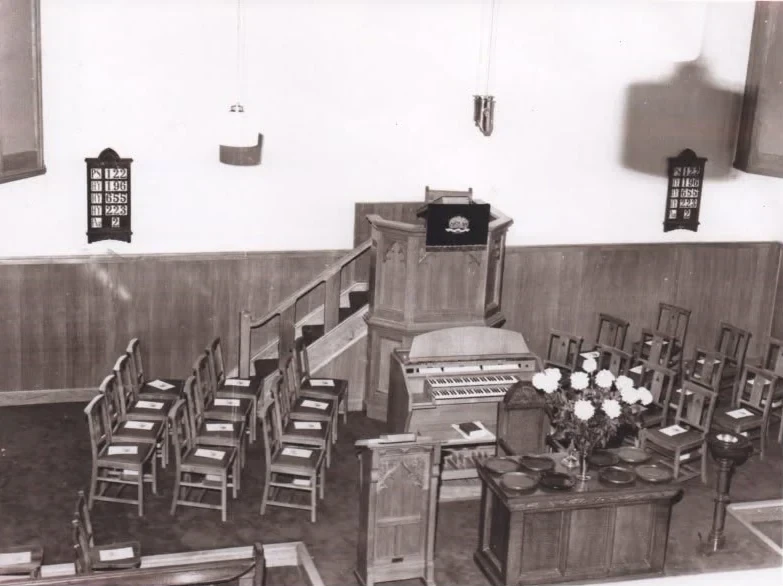
Inside the Meeting House
A surviving place of worship, not simply an empty shell.
This historic interior view preserves details of the Meeting House in use: the pulpit, organ, communion table, seating, hymn boards and timberwork that gave the building its character.
Images like this are important to the conservation story because they record not only architectural features, but how the space was arranged, experienced and remembered by generations of local families.
1843 to today
The use changed. The connection did not.
The Meeting House remained in religious use until around 1980, when the congregation moved to the newer church farther along Main Road. After decades without regular use, the old building faced an uncertain future.
CHG was formed on 31 October 2019 largely from concern for its future. The aim remains to conserve what makes the building special and return it to useful community life as a home for local heritage and activity.
Community voice from the start
The community-hub idea came before consultants and planning applications.
In 2019 CHG asked local people what they wanted the Old Meeting House to become. A public meeting on 31 October invited residents to help shape its future, and a later CHG update recorded strong support for keeping the building as a village landmark.
Suggestions ranged from heritage, learning and youth activities to arts, crafts, music, cookery, gardening, older people's activities and social uses. That early consultation is important: the present community vision grew from local ideas at the very beginning of CHG's story.
The graveyard
Caring for the people and stories around the building.
The historic graveyard surrounding the Meeting House is an inseparable part of the site. After years of becoming increasingly overgrown, Cloughey Heritage Group undertook the considerable job of bringing it back under control, clearing vegetation and improving access for families visiting and tending graves.
That initial work was only the beginning. The grounds need regular attention to stop them slipping back into the condition CHG inherited. The Group now employs a contractor for ongoing maintenance of the graveyard.
CHG would also like to develop a simple way for local people and families with relatives buried here to make an annual contribution towards the cost of maintaining the graveyard. The aim is straightforward: keep the burial ground cared for, accessible and respected for generations to come.
Families with a connection to the graveyard who would like to help with its continuing care can contact Cloughey Heritage Group by email →
Understanding before intervening
Conservation starts with knowing the building.
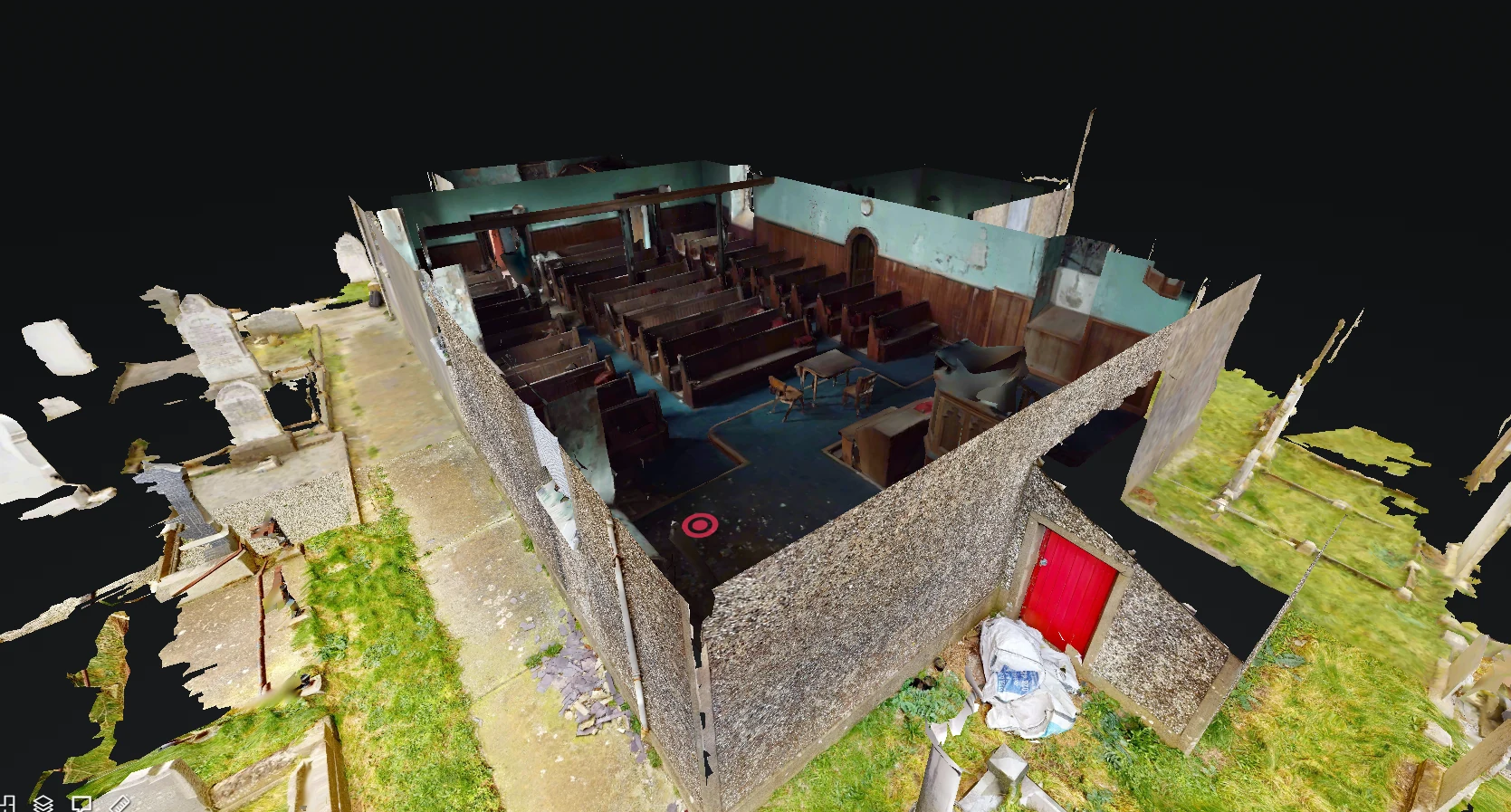
Bringing a protected historic building back into use requires far more than simply repairing what can be seen. CHG has worked with conservation, architectural and engineering professionals to understand the Meeting House and develop proposals that respect its historic character. The work completed for the project has included structural, timber, traffic and bat surveys, alongside measured survey, conservation and design work.
This three-dimensional survey records the building as it exists and gives a remarkable view into the historic interior.
Detailed technical drawings, specifications and sensitive project information are intentionally not reproduced on this public website.
Planning & conservation
Working through the statutory process.
Because the Old Meeting House is a protected historic building, the project requires both normal planning consideration and the separate controls that apply to alterations to a listed structure.
Planning application LA06/2024/0661/F covers the proposed change of use of the former church to a community building. The associated Listed Building Consent application LA06/2024/0660/LBC deals with the proposed conservation and alteration of the protected structure.
CHG's 2026 AGM development report recorded that a planning decision was still awaited. The official Planning Portal provides the latest status of the applications. Restoration or development work will not proceed until the necessary statutory approvals and subsequent requirements are in place.
View the public planning record →The next chapter
Not a new idea — a continuation of its story.
The Old Meeting House has served Cloughey in different ways for generations. CHG's vision is to preserve that heritage while returning the building to active community use.
Conserve
Protect the character, fabric and special features of a B1 listed building and its historic setting.
Heritage
Create a lasting home for photographs, records, research, exhibitions and the stories of Cloughey and the surrounding area.
Community
Bring a long-closed building back into useful life as a welcoming place for talks, activities, events and local groups.
Our flagship project
Protecting a historic building. Creating a place for community life.
Our ambition is not simply to restore the Old Meeting House as a building, but to bring it back into regular, sustainable use. Heritage will remain at its heart, alongside community activities organised by local groups and other users.
- Heritage and learning: displays, local-history talks, research and opportunities to explore the story of Cloughey and the Ards Peninsula.
- Community use: a welcoming venue that could be hired for suitable classes, meetings, workshops and family occasions.
- A sustainable future: appropriate use and venue hire could help meet running and maintenance costs while protecting the building's historic character.
Evidence of interest: CHG has received 12 letters of intent expressing interest in using the proposed venue. These indicate potential demand; they are not confirmed bookings or guarantees of future income.
The scale and type of activities will depend on statutory approvals, funding, conservation requirements and the facilities ultimately delivered. This remains a proposed project, not an open venue.
Building the project
A small group taking on a very large task.
CHG has been working through research, surveys, conservation advice, design development, planning and funding needed to give the Old Meeting House a viable future.
Village Catalyst support helped the Group test sustainable community uses for the building, with the Architectural Heritage Fund involved in that early development stage. In 2024 the Pilgrim Trust supported further development and design work.
These are development steps, not the full restoration. Conserving a building of this age and significance will require substantial further funding, and CHG continues to build the project while caring for the site in the meantime.
Sources & further reading
Research should be traceable.
CHG's history of the Meeting House draws on Presbytery records, contemporary newspapers, listed-building information, planning records and the Group's own project archive, including its 2019–21 consultation and campaign material. These sources provide useful starting points for further research.
NI Planning Portal — public application record →Contemporary 1883 report of the Wild Deer wreck →Department for Communities — Village Catalyst support →Architectural Heritage Fund — Village Catalyst and the Old Meeting House →Pilgrim Trust — 2024 preservation & conservation grants →Listed-building record and architectural history →
Its past gives us the reason
Help us give the Old Meeting House a future.
From a congregation searching for somewhere to meet in 1841, to sheltering the passengers of the Wild Deer in 1883, the Old Meeting House has repeatedly been a place where people came together.
CHG wants that story to continue — preserving an important part of Cloughey's past while creating a place that can serve the community again.